
Introduction
Industrial buying decisions rarely fail because of missing specifications. They fail because the right questions were never asked at the right depth. Pillow block bearings sit quietly inside machines, yet their performance governs uptime, vibration behaviour, energy loss, and maintenance cycles across entire plants. Treating them as interchangeable catalogue items is one of the most expensive assumptions made in heavy industry.
This article strips away generic procurement advice and focuses on the questions that expose engineering maturity, manufacturing discipline, and long-term reliability. These are the questions that experienced plant heads and reliability engineers raise when evaluating a pillow block bearing manufacturer, not because brochures demand it, but because field failures force it.
How Are Load Ratings Defined Beyond the Catalogue?
Load ratings look authoritative on paper, yet those numbers mean little without understanding the conditions under which they were derived. This question sets the foundation for every performance promise that follows.
Real Operating Load vs Rated Load
Clarification must be sought on whether published dynamic and static load ratings reflect continuous duty, variable load cycles, or intermittent shock conditions. Bearings operating under crushers, mixers, or heavy conveyors rarely see steady-state loads. Manufacturers that calculate ratings assuming ideal alignment and constant speed often underperform in real installations.
Safety Margins Embedded in Design
Equally critical is whether additional safety margins are incorporated for contamination, temperature rise, lubrication decay, and mounting imperfections. A pillow block bearing manufacturer that openly discusses these allowances signals design ownership rather than marketing compliance.
What Housing Engineering Decisions Influence Long-Term Stability?
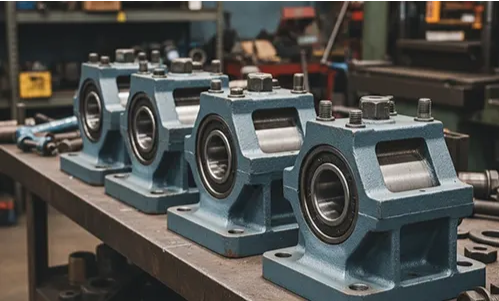
The bearing insert attracts attention, yet the housing determines how loads are transferred, how heat dissipates, and how alignment is preserved over time. Ignoring housing design is a recurring industrial mistake.
Material Integrity and Structural Behaviour
Understanding whether housings are produced from grey cast iron, ductile iron, or steel is only the first step. What matters is consistency of material chemistry, graphite structure, and tensile behaviour under cyclic stress. Weak housings distort, crack, or loosen long before the bearing insert reaches fatigue life.
Casting and Machining Discipline
Inquiry must extend into casting methods, heat treatment controls, and machining tolerances. Flatness of the mounting base and concentricity of the bore directly affect load distribution. Housing inaccuracies quietly destroy bearings while appearing dimensionally acceptable.
How Is Shaft Fit Engineered and Controlled?
Shaft-related failures account for a disproportionate share of bearing damage. Fretting corrosion, inner ring creep, and premature wear often trace back to poor fit strategy rather than bearing quality.
Locking System Suitability
Set screws, eccentric collars, and adapter sleeves behave very differently under vibration and reversing loads. Each has limits. The correct question is not which system is offered, but which system is recommended for the specific application envelope.
Tolerance Compatibility Assurance
Clarification is required on shaft tolerance standards used during bearing design. Bearings manufactured without strict tolerance alignment force installers to compensate on site, creating invisible reliability risks.
What Sealing System Protects Against Real Contamination?
Seals are often described using marketing language rather than performance data. In contaminated environments, sealing design dictates bearing life more than load capacity.
Seal Material and Environmental Limits
Questions must address seal material behaviour under temperature extremes, chemical exposure, and washdown regimes. Materials that perform well in dry conditions may fail rapidly in moisture or abrasive dust.
Proven Contamination Resistance
A pillow block bearing manufacturer with proven sealing performance in cement plants, steel mills, or outdoor installations demonstrates validation through exposure, not assumption. This distinction matters.
How Is Lubrication Strategy Engineered into the Bearing?
Lubrication failure rarely announces itself early. It manifests as heat, noise, and energy loss long before seizure. The responsibility for lubrication clarity does not end with a grease nipple.
Grease Compatibility and Degradation
Clear guidance must exist on grease type, thickener compatibility, and relubrication frequency. Incompatible grease mixing remains a leading cause of bearing failure in industrial plants.
Grease Path Effectiveness
Relubrication ports must deliver grease to rolling elements, not merely into empty cavities. Poor internal grease channel design gives false confidence while accelerating wear.
What Quality Control Systems Prevent Batch-Level Variability?
One good bearing proves nothing. Consistency across thousands of units defines a reliable supplier. This question separates process-driven manufacturers from batch-dependent ones.
Traceability and Batch Identification
Batch or heat-level traceability enables accountability. Without it, root cause analysis becomes guesswork, and corrective action loses precision.
Inspection and Testing Depth
Dimensional inspection, hardness verification, and noise screening reveal far more than visual checks. A mature pillow block bearing manufacturer integrates these controls as routine practice.
How Is Misalignment Managed in Practical Installations?
Perfect alignment exists only on drawings. Bearings must tolerate deviation without punishing the machine.
Internal Design Tolerance
Clarification is required on internal geometry that permits limited angular misalignment while maintaining contact integrity. Overly rigid designs fail quietly through fatigue rather than catastrophically.
Housing Contribution to Alignment Stability
Housing stiffness, base thickness, and mounting surface accuracy directly affect misalignment behaviour. Integrated insert–housing design indicates deeper engineering accountability.
What Compliance and Certification Claims Are Actively Maintained?
Certifications matter only when supported by discipline. This question filters genuine compliance from decorative documentation.
Ongoing Manufacturing Compliance
Active audits, documented process controls, and continuous improvement mechanisms define meaningful certification. Static certificates alone offer little assurance.
Application-Specific Requirements
Industries with hygiene, export, or safety mandates require material, lubrication, and design compliance aligned with regulatory expectations.
How Are Failures Investigated and Corrected?
Failures are inevitable. How they are handled defines future performance.
Root Cause Analysis Capability
Access to metallurgical examination, wear pattern analysis, and lubrication assessment reflects engineering maturity rather than reactive troubleshooting.
Design Feedback Integration
A pillow block bearing manufacturer that feeds failure insights back into design and process improvement demonstrates long-term reliability commitment.
What Technical Support Exists After Delivery?
Support quality becomes visible only after installation. This question exposes whether a supplier views supply as a transaction or a partnership.
Installation and Commissioning Guidance
Clear torque values, alignment practices, and mounting instructions reduce early-life failures dramatically.
Product Continuity and Consistency
Long-term availability, dimensional consistency across batches, and transparent change management protect plants from forced redesigns and inventory disruption.
Closing Insight
The real cost of a pillow block bearing is not its purchase price. It is the downtime, energy loss, and maintenance escalation that follow poor selection. The questions outlined above cut through surface-level comparison and expose the engineering discipline behind the product. A capable pillow block bearing manufacturer does not deflect these questions. Such questions are welcomed, answered clearly, and backed by process maturity rather than marketing language.