
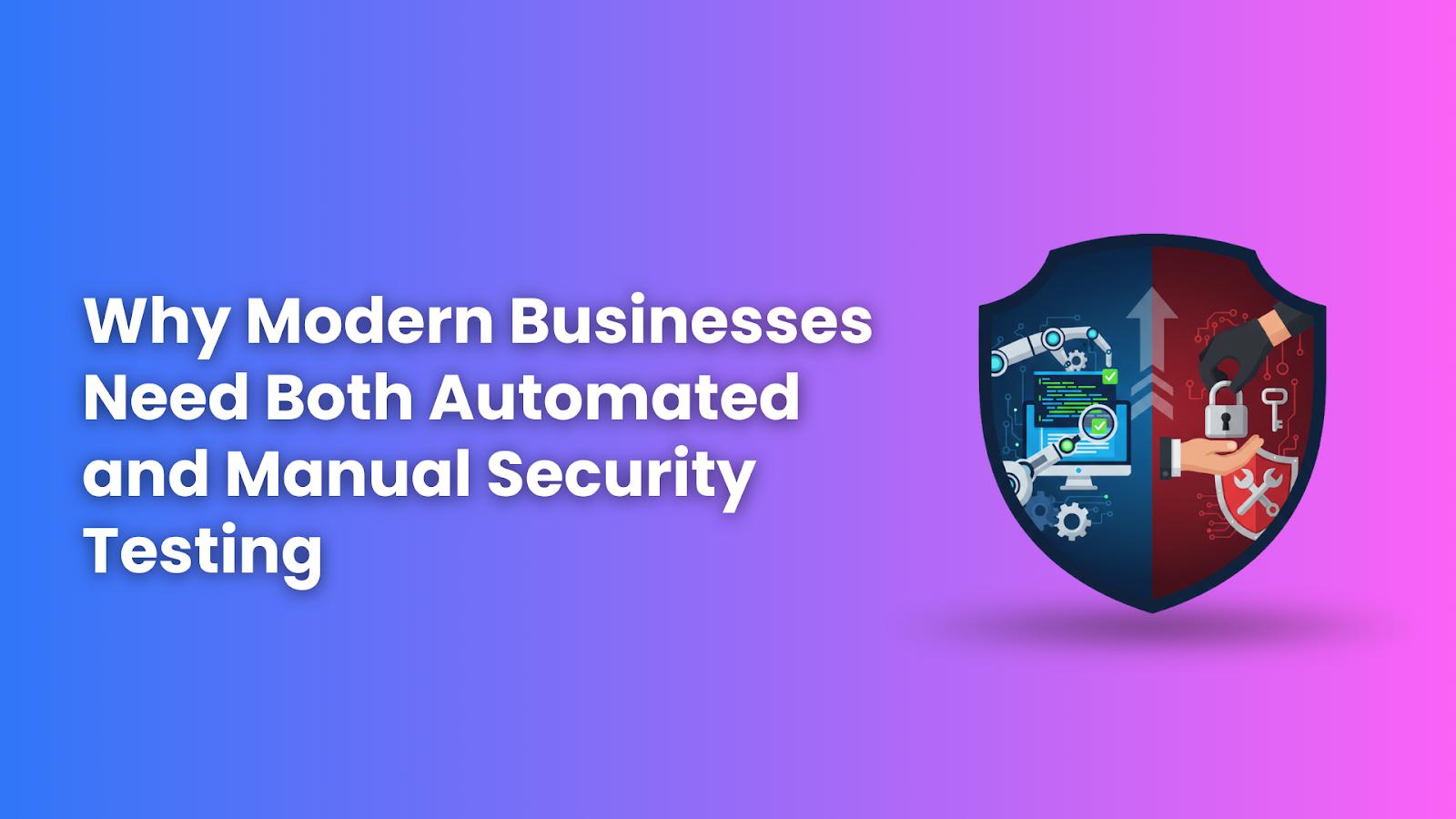
In the current highly integrated digital economy, threats to security change at a more rapid rate than ever before. The use of clouds, remote workforces, APIs, mobile applications, and third-party integrations has significantly increased the area of attack of all organizations. Vulnerability Assessment and Penetration Testing (VAPT Testing) is no longer an option in this environment. It is one of the fundamental business needs. Nevertheless, it is not sufficient to use a single method of testing. Automated and manual security tests are required in modern businesses to identify, validate, and rectify the security risks in time before the attackers can exploit the vulnerabilities.
Understanding VAPT Testing in a Modern Context
VAPT Testing is a process of security assessment that incorporates two activities that are mutually complementary.
- Vulnerability Assessment (VA): This is the process of identifying the known security weaknesses of systems, applications, and networks.
- Penetration Testing (PT): This is to simulate the real world attacks to see whether the vulnerabilities can indeed be exploited.
Although the goal is the same, i.e., to minimize the security risk, the way of implementation is as important. This is the place of both automated and manual testing, whose functions are different yet equally important.
The Role of Automated Security Testing
Tools and scanners in automated security testing are used to detect vulnerabilities at scale and in a brief period of time. These tools are based on constantly revised databases of existing vulnerabilities and misconfigurations.
Key Benefits of Automated Testing
- Speed and Scalability: Automated tools can scan thousands of assets in hours, and therefore, they suit large and dynamic environments. In high-velocity DevOps or CI/CD pipelines, automation is used to provide security that is equal to development.
- Constant and Repeatable Results: Automated scans are run according to pre-determined rules and signatures that minimize human error and allow consistent baseline tests in different environments.
- Early Discovery of Existing Vulnerabilities: Automation is highly effective in identifying general problems like old software versions, patch deficits, insecure settings, and familiar CVEs established in structures such as the OWASP Top 10.
- Economical Testing: In cases of regular checkups and follow-ups, automated tests offer extensive coverage at a moderately low price.
Limitations of Automation
Automated testing has apparent limitations, although it has its benefits. They have high false positives, poor business logic knowledge, a deficiency in creative chaining of vulnerabilities, and the inability to detect zero-day vulnerabilities or context-specific vulnerabilities. At this stage, manual testing is required.
Why Manual Security Testing Still Matters
Manual penetration testers are competent security experts who reason and behave as actual attackers. They do not wait and hope that a signature will work, but they use experience, creativity, and understanding of the situation.
Strengths of Manual Testing
- Real-World Attack Simulation: Human testers can combine various low-risk problems into a high-impact attack, which is usually not detected by automated tools.
- Business Logic and Context Awareness: Manual testers are aware of how applications are expected to operate, and they can detect defects like privilege escalation by the use of workflow misuse, bypassing authorization, and insecure role management.
- Automated Findings validation: Manual testing can be used to identify if the reported vulnerabilities are actually exploitable, which minimizes the noise and enables teams to focus on actual risk areas.
- Unknown Vulnerability Discovery: Zero-day vulnerabilities, custom code defects, and complex attack paths cannot be discovered automatically and are best discovered through human analysis.
Limitations of Manual Testing
This cannot be done by manual testing. It is also time-consuming, resource-intensive, has a limited scope relative to automation, and is not practically scalable to a continuous coverage in a large environment.
Why Businesses Need Both: The Hybrid VAPT Approach
The current threat environments require a defense-in-depth strategy of testing security. Manual and automated testing are not opposing methods. They are complementary.
How Automated and Manual Testing Work Together
| Automated Testing | Manual Testing |
| Broad vulnerability discovery | Deep exploit validation |
| Continuous scanning | Targeted, high-risk analysis |
| Detects known issues | Finds logic and zero-day flaws |
| Scales easily | Provides human insight |
The combination of the two will result in organizations becoming more vulnerable, detection accurate, with fewer false positives, improved risk prioritization, and more compliance prepared.
Compliance, Risk, and Business Impact
VAPT Testing is expressly or implicitly mandated in numerous regulatory frameworks and industry standards, such as ISO 27001, PCI DSS, SOC 2, HIPAA, and GDPR security requirements.
The Automated scans are able to meet the frequency and coverage requirements, whereas the manual testing is able to meet the depth and effectiveness requirements. They act jointly to show due diligence towards regulators, customers, and stakeholders.
There is more than compliance business impact. Companies have minimized the risk of information breaches, decreased the cost of responding to an incident, safeguarded brand reputation, and gained customer confidence.
Supporting Secure DevOps and Cloud Environments
In the contemporary business landscape, there are agile and cloud-native ecosystems with a daily infrastructure change. This fact is supported by a hybrid model of VAPT, which combines automated scans into CI/CD pipelines, periodic manual testing of significant releases, constant monitoring of the production environment, and changing fast based on new methods of attack.
Security gains the status of an ongoing process and not an annual checklist.
Best Practices for Implementing Hybrid VAPT Testing
Maximizing the value of both techniques should be achieved by automating early and frequent presence of environments in development and staging, manual tests of vulnerabilities at least once a year or after a significant change, ranking vulnerabilities by exploitability instead of solely basing on severity scores, post-remediation retesting, and testing in line with business risk rather than only technical metrics.
Conclusion
The nature of cyber threats nowadays is advanced, enduring, and very dynamic. Their defense cannot be achieved with only one tool or methodology. VAPT Testing with automated efficiency and manual skill offers a balanced and realistic perspective of security, which is required by the current business establishment.
Speed, scale, and consistency are provided by automated testing. Manual testing provides richness, innovation, and validation in the real world. The combination of them creates a strong security testing plan that can help not only to determine vulnerabilities but also mitigate actual business risk.
To the organizations that take the issue of digital assets, customer information, and brand image seriously, it is no longer a matter of whether to conduct VAPT Testing, but how well it is done, both through automated and manual methodology.